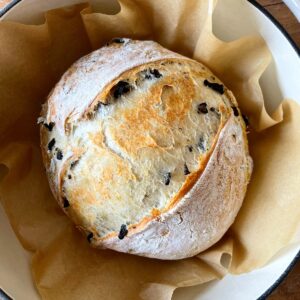
Crispy No-Knead Olive Artisan Bread
A simple, beginner-friendly recipe, this No-Knead Olive Artisan Bread is made with briny, salty olives and deliciously seasoned with oregano. With a soft, airy crumb and a crispy crust, it pairs perfectly with rich, tomato-based pastas, soups and stews.
Ingredients
- 1½ cups water, room temperature (at or near 70°F/21°C)
- 1 teaspoon active dry yeast
- 3 cups bread or all-purpose flour, plus more for dusting
- 1 cup olives, pitted, dried and roughly chopped
- 1 teaspoon kosher or fine sea salt
- 1 teaspoon dried oregano
- 2 teaspoons extra-virgin olive oil
Instructions
- Add the yeast to the water and let it sit for 10-15 minutes. In a large mixing bowl, whisk together flour, dried olives, salt and oregano and let sit for 10 minutes.
- Add yeast mixture and olive oil to the bowl and mix just until combined. The dough should look a little sticky and stringy and there should still be a little flour around the edges of the bowl.
- Cover and let rise somewhere warm until it has doubled in size (see note below).
- Once the dough has doubled in volume, use your hands (or a dough scraper if you have one) to pull the dough out onto a floured surface. With floured hands, gently fold the dough into itself several times until a soft, flour-covered ball is formed. Place it into a flour dusted bowl, dust with flour, cover and refrigerate overnight. You can even leave it for as long as 48 hours at this point if you’re not able to bake it right away.
- When you're ready to bake your bread, preheat oven to 450ºF (232ºC) with your Dutch oven inside the oven.
- Once the oven is preheated, turn the dough out onto a generously floured surface. Flour your hands and gently turn it, adding bits of flour as your go, nudging it into the shape of a loaf. Place it on a sheet of parchment paper and score the top with a razor blade or the tip of a sharp knife with a design of your choosing. This will allow steam to escape while it’s baking.
- Remove the Dutch oven from the oven and transfer the dough, still on the parchment, into the Dutch oven. Cover and bake for 30 minutes, then remove the cover and bake for 15-20 minutes more. Your bread will be done once the top is browned, and it sounds hollow when you tap the top.
- Using parchment edges, lift bread from Dutch oven and transfer it to a wire cooling rack to let cool for up to an hour before slicing.
Notes
Olives: Don’t skip drying the olives! This is easily done by laying them out between two paper towels or wrapped in a dry kitchen towel.
Rise time and temperature: An ambient rise temperature somewhere between ~70º-75º/20º-23ºC is ideal but even high 60's/18º-19ºC should work if the dough is kept away from drafts. Note that rise times can vary based on temperature, environment and ingredients used. You will know your loaf is ready to bake when it has doubled in size, and this can take a minimum of 2-3 hours or as long as a full day. With a little experimentation, you will find the time frame that works best for you.
Storage: This bread will keep well stored in a paper bag or bread box at room temperature for 2 to 3 days or slice it and freeze in a well-sealed plastic bag for up to 3 months.